Key Points
- Meaningful pilot totals: Figure 02 completed a six‑month run at Baoma Jituan 宝马集团 (Spartanburg), contributing to roughly ~30,000 BMW X3 vehicles and handling >90,000 parts over >1,250 hours with an estimated >1.2 million steps (~200 miles / ~322 kilometers).
- Practical deployment role & KPIs: Deployed for upstream pick‑and‑place tasks; target metrics included cycle time <84 seconds, positioning accuracy >99% per shift, and 0 interventions per shift.
- Engineering weakness and redesign: The forearm had the highest failure rate due to compact packaging, multi‑axis demands, and thermal limits; Figure retired Figure 02 and re‑architected forearm/wrist electronics in Figure 03 to improve reliability.
- Industry implication: The pilot shows humanoids can complement existing automation, but industry fragmentation and lack of standardization may slow mass adoption — clearer small‑volume V3 signals are expected in early 2026.

Quick summary
Humanoid robots in factories just logged a meaningful pilot run.
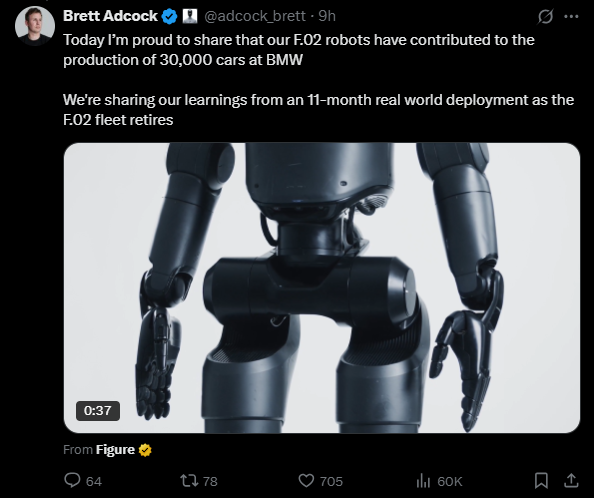
Figure (Figure) reports that its second‑generation humanoid, Figure 02, completed a six‑month pilot at BMW Group (Baoma Jituan 宝马集团) — Spartanburg plant.
The pilot participated in the production of roughly 30,000 BMW X3 vehicles.
During the run, the robots handled more than 90,000 parts, operated for over 1,250 hours, and are estimated to have walked more than 1.2 million steps (~200 miles / ~322 kilometers).

Find Top Talent on China's Leading Networks
- Post Across China's Job Sites from $299 / role
- Qualified Applicant Bundles
- One Central Candidate Hub
Your First Job Post Use Checkout Code 'Fresh20'

What Figure reported — operational totals
Brett Adcock (Bu Lei Te · A De Ke Ke 布雷特·阿德科克), founder and CEO of Figure (Figure), reshared the company’s update on November 19, 2025.
The company disclosed these totals for the Spartanburg pilot:
- Vehicles involved: ~30,000 BMW X3s
- Parts loaded by Figure 02 robots: >90,000 parts
- Total operating time: >1,250 hours
- Estimated distance walked: >1,200,000 steps (~200 miles / ~322 kilometers)

ExpatInvest China
Grow Your RMB in China:
- Invest Your RMB Locally
- Buy & Sell Online in CN¥
- No Lock-In Periods
- English Service & Data
- Start with Only ¥1,000
How Figure 02 was used on the production line
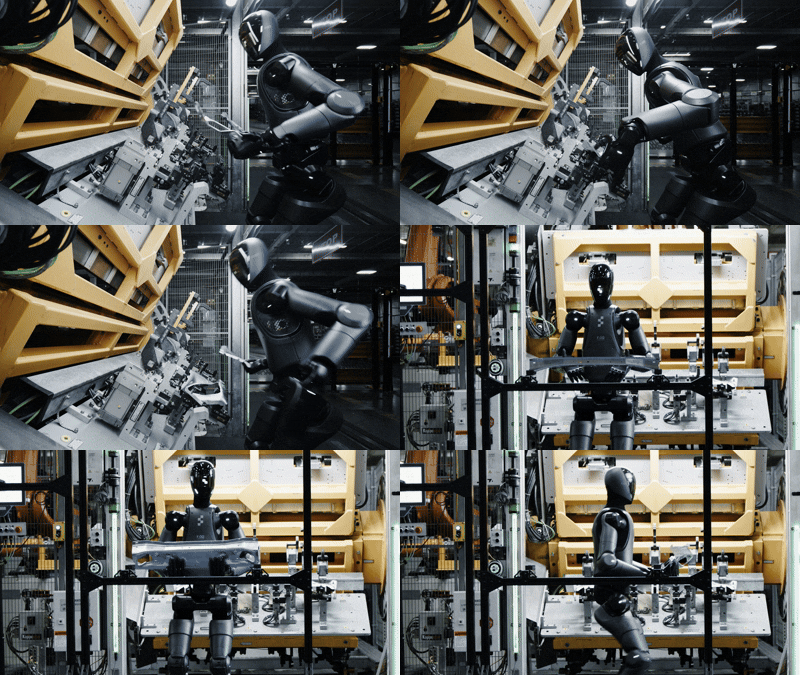
Public images and descriptions show Figure 02 performing pick‑and‑place tasks.
The humanoid removes stamped metal panels from racks or bins.
The robot places panels onto welding fixtures.
Conventional six‑axis industrial robots then perform the welds and transfer assembled parts into the main production line.
Figure 02’s role was handling, positioning and loading upstream of standard robotic welding and downstream flow.

Resume Captain
Your AI Career Toolkit:
- AI Resume Optimization
- Custom Cover Letters
- LinkedIn Profile Boost
- Interview Question Prep
- Salary Negotiation Agent
KPIs, targets, and how performance was measured
Figure defined specific KPIs for the pick‑and‑place work to quantify progress.
Target metrics disclosed included:
- Cycle time: total time to complete the sequence (including opening the welding fixture door, loading, etc.) — target < 84 seconds per cycle.
- Positioning accuracy: proportion of shifts in which all three stamped panels were loaded correctly — target > 99% success per shift.
- Intervention count: number of times human operators had to pause or reset the robot — target = 0 interventions per shift.
Known issues: the forearm remains the weak link
Figure acknowledged that Figure 02’s front arm (the forearm) had the highest failure rate among subsystems.
The vulnerability stems from three factors:
- Compact packaging required in that segment.
- Multiple axes of flexibility needed (three degrees of freedom).
- Thermal limits associated with that design area.
In short, packaging density, required mobility, and heat management make the forearm a particularly challenging subassembly.
The article notes that dexterous hands and forearms are among the toughest engineering problems in humanoid robotics.
Tesla (Tesla Tesla 特斯拉) reported similar issues with Optimus prototypes — cooling for motors and shortened component lifetimes were reported problems.
Elon Musk has repeatedly said that building hands and forearms for humanoid robots is an especially difficult engineering challenge because many actuators and control complexities that emulate human hand function live in the forearm.
Retirement of Figure 02 and the shift to Figure 03
Figure publicly unveiled Figure 03 and has begun retiring Figure 02 units.
The company recalled deployed Figure 02 machines from BMW’s headquarters.
Figure says the operational experience from Figure 02 will inform manufacturing processes, component architecture and mechanical redesigns for Figure 03.
Specifically, Figure says Figure 03 re‑architects electronics in the forearm and wrist.
The company removed a distribution board and dynamic cabling routes in that area to reduce complexity, improve reliability, and simplify thermal management.
Industry context — fragmentation and convergence
The pilot highlights that the humanoid robotics industry has not converged on standard designs or scene definitions.
Orient Securities (Dongfang Zhengquan 东方证券) commented the sector still lacks consensus on fundamentals like locomotion (biped vs. wheeled), mechanical architecture of dexterous hands, necessity of linear joints, component choices, and robot sizing.
That fragmentation creates many SKUs (stock keeping units).
Multiple SKUs can dilute industry capital and engineering focus and slow the emergence of embodied intelligence at scale.
The brokerage also noted sentiment for robot mass production has cooled and the robotics sector has pulled back recently.
Orient Securities expects clearer signals of small‑volume production and initial V3 deployments in early 2026.
The first quarter of 2026 could be a key signal if V3 units begin limited production.
What this means for investors, founders, and operators
If you build, invest in, or deploy industrial robotics, this pilot provides a handful of practical implications:
- Field data matters. Real production runs expose subsystem weaknesses — especially in compact, thermally constrained components like forearms and wrists.
- Iterate fast, but expect recalls. Retiring Figure 02 in favor of Figure 03 is a normal hardware cycle: deploy → learn → redesign → redeploy.
- Standardization unlocks scale. Lack of scene and design consensus can slow capital efficiency; convergence will likely be a precursor to broader mass production.
- Robots complement, not replace, existing automation. In this pilot, humanoids handled upstream pick‑and‑place while conventional six‑axis robots handled welding — a hybrid flow is realistic today.
- KPIs are critical for deployment decisions. Cycle time, accuracy and interventions are practical metrics for evaluating ROI and operational readiness.
Takeaway
The BMW pilot proves humanoid robots can contribute to complex automotive lines for repetitive handling tasks.
Hardware durability — particularly in forearms and hands — plus thermal and reliability engineering remain central obstacles.
Figure’s retirement of Figure 02 and redesign toward Figure 03 follows a classic hardware product‑iteration pattern: field data → targeted redesign → redeployment.
Industry consensus and standardization will be important before broad, high‑volume adoption can scale.
Humanoid robots in factories are making practical progress, but the path to mass adoption still demands engineering, standardization, and realistic deployment KPIs.