Key Points
- Xiaomi EV (小米汽车) has filed a patent for a “Fatigue Driving Intervention Method” that combines vehicle data with biometric data from wearables for highly accurate fatigue detection.
- The system uses a dual-data approach, analyzing vehicle behaviors (steering, acceleration) and driver biometrics (heart rate, sleep quality) to synthesize the driver’s exhaustion level, improving precision over single-input systems.
- Interventions are tailored to the degree of fatigue, ranging from gentle haptic feedback for minor fatigue to aggressive warnings or autonomous driving suggestions for severe cases.
- This innovation highlights Xiaomi’s
integrated ecosystem approach, building safety into the smart cockpit architecture and leveraging wearable integration, positioning them as pioneers in software-first automotive safety.
- Dual-Data Input: Combines real-time vehicle behavior with wearable biometric data.
- AI Synthesis: Analyzes data streams to determine exact exhaustion levels.
- Tiered Response: Delivers specific interventions based on fatigue severity.
- Device Integration: Uses cars, watches, and phones to provide multi-channel alerts.

Xiaomi (Xiao Mi 小米) just filed a patent that combines wearable tech with vehicle systems to prevent driver fatigue—and it’s a fascinating look at how Chinese automakers are approaching safety innovation.
What Xiaomi EV Just Patented: The Full Picture
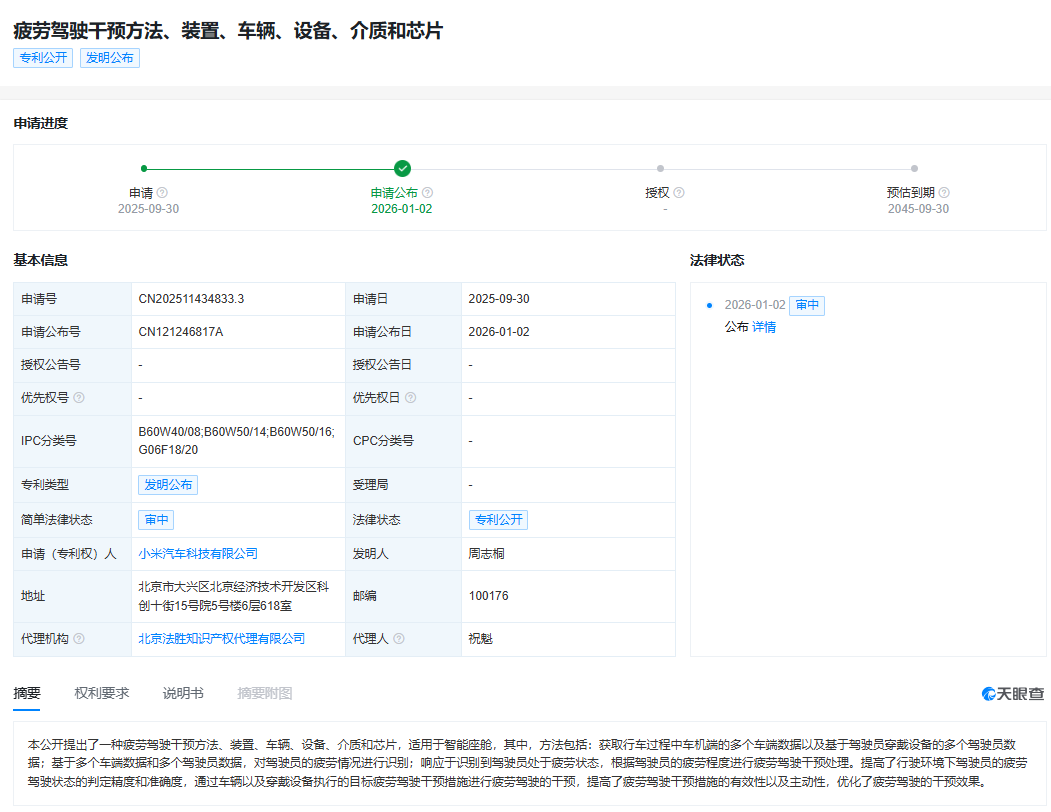
According to intellectual property data from Tianyancha (Tian Yan Cha 天眼查), Xiaomi EV (Xiao Mi Qi Che 小米汽车) Technology Co., Ltd. recently published a patent titled “Fatigue Driving Intervention Method, Apparatus, Vehicle, Equipment, Medium, and Chip.”
Here’s the thing: this isn’t just another driver-monitoring system.
The patent is specifically designed for smart cockpits, which means it’s built into the vehicle’s intelligence infrastructure from day one.

Find Top Talent on China's Leading Networks
- Post Across China's Job Sites from $299 / role
- Qualified Applicant Bundles
- One Central Candidate Hub
Your First Job Post Use Checkout Code 'Fresh20'

How the Dual-Data Approach Works
The system operates on a pretty elegant principle: combine vehicle data with biometric data from wearables to create a more accurate fatigue detection model.
Here’s the breakdown:
- Vehicle-end data: The car collects multiple data sets from its own systems during driving (think: steering patterns, acceleration behavior, lane-keeping precision).
- Driver biometric data: Wearable devices feed real-time health metrics into the vehicle’s system (heart rate variability, sleep quality indicators, stress levels).
- Synthesis & analysis: The system synthesizes both data streams to identify the driver’s actual level of exhaustion.
This dual-data approach is where Xiaomi EV is getting clever.
Most fatigue detection systems rely on a single input—either vehicle behavior or biometric data.
By combining both, the system significantly improves the precision and accuracy of fatigue detection in real driving conditions.

ExpatInvest China
Grow Your RMB in China:
- Invest Your RMB Locally
- Buy & Sell Online in CN¥
- No Lock-In Periods
- English Service & Data
- Start with Only ¥1,000
The Intervention Strategy: Beyond Simple Alerts
Here’s where it gets interesting.
Once the system identifies that a driver is fatigued, it doesn’t just send a generic “You’re tired, stay alert” notification.
Instead, the intervention is tailored to the specific degree of fatigue detected.
The system can deploy different responses depending on severity:
- Minor fatigue: Gentle haptic feedback on the steering wheel or seat.
- Moderate fatigue: Audio alerts combined with wearable device notifications.
- Severe fatigue: More aggressive interventions that prompt immediate rest or suggest autonomous driving activation (if available).
By executing targeted intervention measures through both the vehicle hardware and the driver’s wearable devices, the system enhances effectiveness.
It’s not just reacting to fatigue—it’s proactively preventing accidents before they happen.

Resume Captain
Your AI Career Toolkit:
- AI Resume Optimization
- Custom Cover Letters
- LinkedIn Profile Boost
- Interview Question Prep
- Salary Negotiation Agent
Why This Matters for EV Adoption
Safety is still the #1 concern holding back mainstream EV adoption.
While most of the conversation centers on autonomous driving capabilities and battery safety, driver fatigue remains one of the leading causes of accidents on the road.
What Xiaomi EV is doing here is positioning itself differently:
- Integrated ecosystem approach: They’re not bolting on a safety feature—they’re building it into the smart cockpit architecture.
- Wearable integration: This assumes drivers will be wearing connected devices (smartwatches, rings, etc.), which ties into the broader IoT ecosystem.
- Data-driven intervention: Using real-time biometric and vehicle data means the system learns and adapts to individual drivers over time.
- Competitive positioning: Traditional automakers are slower to innovate on software-driven safety features—Xiaomi has the agility to move faster.
This patent is a perfect example of how Chinese tech companies are approaching automotive innovation: software-first, ecosystem-second, hardware integration third.
The Bigger Picture: Smart Cockpits as the New Battleground
The shift toward smart cockpits isn’t just about adding screens to cars.
It’s about creating an intelligent co-pilot experience that learns driver behavior, predicts needs, and intervenes when necessary.
Xiaomi’s patent filing signals that they’re taking this seriously.
By combining vehicle systems + wearable data + AI-driven analysis, they’re building a safety layer that traditional automakers struggle to replicate quickly.
For investors and founders watching the EV space, this is worth paying attention to.
Safety features like fatigue detection won’t be a differentiator in 5 years—they’ll be table stakes.
The question is: who builds it best first?
Xiaomi EV’s approach to fatigue driving intervention patent technology shows they’re thinking about this differently than the competition.