Key Points
- For the first time, a tech company, Cambricon (Hanwu Ji 寒武纪), dethroned Kweichow Moutai (Guizhou Maotai 贵州茅台) as China’s “Stock King” by closing at ¥1,699.96 RMB ($235.10 USD) by late April 2026, signaling a shift towards an innovation-driven economy.
- This change reflects a move from traditional consumption leaders to hard-tech enterprises like AI chip and optical chip manufacturers, representing a fundamental shift in capital market investment logic in China.
- The market’s focus on tech is driven by the need to develop “new quality productive forces” and address critical “bottleneck” issues in core technologies amidst intensifying global competition.
- Despite the headline stock price changes, some tech leaders, including Cambricon and Yoke ICT, are planning significant stock splits, which will mechanically reduce their nominal share prices, making the “Stock King” title temporary for these companies.
- The economic shift emphasizes a “dual circulation” development pattern, where hard technology acts as the engine of growth, while domestic market consumption (represented by companies like Moutai) provides stability and resilience, indicating that both are complementary for long-term growth.
The A-share market just witnessed something that would’ve seemed unthinkable a few years ago.
For the first time in what feels like forever, a liquor company is no longer sitting at the top of China’s stock price rankings.
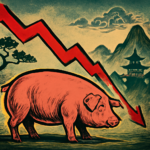
By the final trading day of April 2026, Cambricon (Hanwu Ji 寒武纪) closed at ¥1,699.96 RMB ($235.10 USD) to claim the number one spot, pushing the long-standing “Stock King,” Kweichow Moutai (Guizhou Maotai 贵州茅台), down to third place.
Right on its heels? Yoke ICT (Yuanjie Keji 源杰科技), another hard-tech powerhouse.
This isn’t just a random market shuffle. It’s a signal of something much bigger happening in China’s economy.
—
What Just Happened: The “Stock King” Crown Changes Hands
Let’s break down what actually occurred here.
For years—and we’re talking decades—traditional consumption leaders like Moutai dominated the top of China’s stock price rankings.
These weren’t just any stocks. They were the benchmark investments: stable cash flows, rock-solid brand moats, consistent dividends, and the kind of predictability that institutional investors live for.
Then something shifted.
The recent ascent of tech leaders like Cambricon and Yoke ICT represents something rarely seen before: a collective debut of multiple hard-tech firms fighting for the crown.
This isn’t one or two outlier stocks getting lucky. This is a systemic movement across the entire tech sector reshaping which companies investors believe will drive future growth.
—
Why This Matters: Understanding the Economic Shift
On the surface, this looks like just another market rotation between sectors.
But there’s something deeper happening here—and it matters for anyone paying attention to where China’s economy is headed.
This shift reflects a fundamental change in capital market investment logic. It’s a vivid microcosm of China’s transition toward an innovation-driven economy.
Many hard-tech enterprises have moved from the “technical substitution” phase (where they’re still proving their technology works) to the “performance realization” phase (where they’re actually making money and scaling).
What’s emerging is a new valuation ecosystem defined by what experts call “The Technology Mainline + Value Ballast”—a framework where both innovation and stability play equally important roles.
Translation? The market isn’t abandoning value. It’s just expanding its definition of what “value” means in 2026.
—
The Tech Takeover: Who’s Rising and Why
The rise of tech isn’t isolated to Cambricon and Yoke ICT.
Look at the broader landscape:
- CATL (Ningde Shidai 宁德时代) – The battery leader reshaping energy storage
- BYD (Biyadi 比亚迪) – The NEV (new energy vehicle) pioneer that’s been quietly dominating
- The “Easy-Mid-Sky” optical module trio – A collective name for leading optical communication firms
These aren’t niche plays. They’re becoming the backbone of the market, and for good reason.
In an era of intensifying global competition and critical “bottleneck” issues in core technologies, fields like AI chips and optical chips have become foundational to the entire digital economy.
When capital flows favor these firms, it’s not speculation—it’s rational anticipation of future growth drivers and a direct response to national strategic goals around developing “new quality productive forces.”
In other words: the market believes tech is where the real growth will happen next.
—
The Real Story: It’s Not Tech vs. Moutai
Here’s where most people get this wrong.
They frame this as a binary choice: either you’re betting on chips or you’re betting on liquor.
That’s a false choice.
The actual story is far more nuanced—and far more interesting.
Hard technology is the engine of growth that determines the height and future trajectory of any economy.
Meanwhile, the domestic market (represented by strong consumption plays like Moutai) is the “ballast” that provides economic resilience and stability.
These two forces aren’t competing—they’re complementary.
Without breakthroughs in hard tech, an economy risks getting stuck in low-end competition, churning out commodities and competing on price forever.
But here’s the flip side: without a strong domestic market, those technological breakthroughs can’t actually get commercialized and scaled into real economic value.
Together, they form what economists call the “dual circulation” development pattern—a framework where both international competitiveness and domestic demand drive growth in tandem.
—
The Plot Twist: Stock Splits Are Coming
- Cambricon: Issue 4.9 shares for every 10 shares held (effective May 8)
- Yoke ICT: Issue 4.5 shares for every 10 shares held
- Impact: Nominal share prices will decrease while total shares outstanding increase
Before you start repositioning your entire portfolio based on this shift, there’s a critical detail to understand.
Some of the tech leaders claiming the top spots are about to undergo significant stock adjustments.
Specifically:
- Cambricon (Hanwu Ji 寒武纪) plans to issue 4.9 shares for every 10 shares from capital reserves on May 8
- Yoke ICT (Yuanjie Keji 源杰科技) plans 4.5 shares for every 10
What does that mean? Following these adjustments, their nominal share prices will decrease.
So the “Stock King” title itself is somewhat temporary—these companies’ stock prices will drop mechanically once the splits execute.
The point here: don’t get caught up in chasing headline stock prices.
The real insight isn’t about who holds the number one spot on a given day. It’s about recognizing the systemic shift in where capital is flowing and why—and understanding that this represents a genuine reorientation of China’s economy toward innovation and high-quality growth.
—
What Different Players Need to Do
This shift creates responsibilities for everyone in the ecosystem.
Regulators and Local Governments (The Navigators)
These institutions need to act as “navigators”—providing policy support for hard tech while simultaneously removing institutional barriers to consumption.
The danger? Short-sightedness that ignores traditional industries in favor of trendy “tech tracks.”
Both matter. Both need support.
Capital Market Regulators (The Gatekeepers)
Market regulators must act as “gatekeepers,” guiding the market back to rationality and ensuring it actually serves the real economy.
This includes:
- Optimizing financing structures for tech firms
- Curbing irrational speculation and hype-driven investing
- Maintaining transparency and accountability
A market that chases every shiny new tech company with no regard for fundamentals isn’t serving anyone.
Hard-Tech Enterprises (The Main Force)
Tech companies need to remain the “main force” of innovation—but this requires discipline.
By focusing relentlessly on core R&D and ignoring capital speculation chasing, hard-tech firms can break what critics call the “Moutai Curse”—the trap of becoming a trading vehicle rather than a productive business.
The goal? Become evergreen entities built on genuine self-reliance and technological superiority, not market sentiment.
Consumer Enterprises (The Stabilizers)
Companies like Moutai can’t just sit on their laurels as “traditional” plays.
They need to serve as the “stabilizers” of domestic demand by embracing digital transformation and high-end upgrades that meet the evolving, quality-focused needs of modern consumers.
Consumption isn’t going away—it’s just upgrading.
—
The Investor Playbook: How to Think About This Shift
If you’re an investor trying to make sense of this market realignment, here’s the framework:
Practice “value investing” and avoid “black-and-white” thinking.
Yes, there’s genuine opportunity in tech innovation and capturing growth in AI chips and optical modules.
But that doesn’t mean ignoring the anti-risk value of consumption assets.
The critical skill is learning to distinguish between true growth and “pseudo-themes”.
This means looking past the hype and examining:
- Actual customer orders (not just press releases)
- Real financial reports and cash flow metrics
- Competitive moats and defensibility
- Path to profitability and unit economics
A company can have amazing technology and still be a terrible investment if it’s not generating real economic value or has a path to sustained profitability.
Conversely, a “boring” consumption stock might have more upside than it appears if it’s investing in modernization and tapping new consumer segments.
—
The Bottom Line: Chips and Sauce Both Matter
The “Shift of the Stock King” is real, and it signals something important about where China’s economy is heading.
But the story isn’t “tech wins, traditional loses.”
Instead, it’s: China is simultaneously building both the innovation engine and the domestic demand foundation it needs to sustain long-term growth.
Whether it’s the flash of a chip or the lingering scent of sauce-fragrance liquor (baijiu), a dual-driven approach ensures that the Chinese economy possesses both the power of innovation and the resilience of stability.
For investors, this means staying rational, looking for genuine value creation wherever it appears, and resisting the urge to make binary bets on entire sectors.
The future likely belongs to those who can appreciate both the glow of chips and the fragrance of Moutai—and understand why they need each other to thrive.
—