Key Points
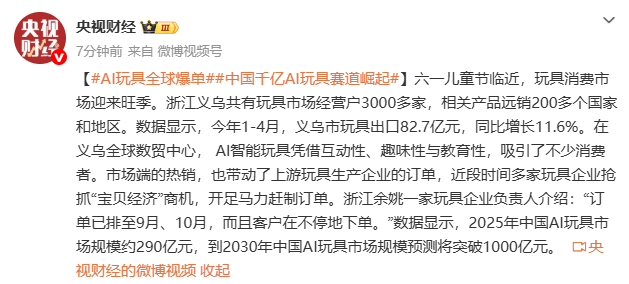
- Yiwu, China, is the global toy epicenter, with over 3,000 operators exporting to 200+ countries; its toy exports hit ¥8.27 billion RMB ($1.16 billion USD) from Jan-April this year, an 11.6% year-on-year increase.
- AI-powered smart toys are driving this growth, offering enhanced interactivity, personalized entertainment, and educational benefits, with manufacturers operating at full capacity and orders scheduled months in advance.
- The market for AI toys in China is projected for massive growth, expected to reach ¥29 billion RMB ($4.06 billion USD) by 2025 and exceed ¥100 billion RMB ($14 billion USD) by 2030.
- This boom highlights the “baby economy” effect, where parents are willing to invest more in toys that offer both entertainment and developmental advantages.
- Interactivity: Conversational capabilities with children
- Personalization: Experiences that adapt to play styles
- Education: Integration of developmental and learning tools
- Investment: The “baby economy” driving higher parent spending

The toy industry is experiencing a seismic shift, and it’s happening in China.
As we head into peak toy-buying season around International Children’s Day (June 1st), something remarkable is unfolding in Yiwu (Yiwu 义乌), a manufacturing hub in Zhejiang (Zhejiang 浙江) province that most Western investors have never heard of.
This is where the global toy supply chain meets artificial intelligence—and the numbers tell a compelling story about where childhood entertainment is headed.
—
The Yiwu Effect: Where 3,000+ Toy Makers Feed the World
Let’s start with some context.
Yiwu isn’t just another manufacturing city.
It’s the global toy epicenter—home to more than 3,000 toy market operators whose products flow to over 200 countries and regions.
To put that scale in perspective, here’s what the data shows:
- From January to April this year, Yiwu toy exports hit ¥8.27 billion RMB ($1.16 billion USD)
- That represents a year-on-year increase of 11.6%
- Growth is happening even as global supply chains normalize post-pandemic
- The momentum suggests sustained demand for toys globally, not just temporary consumer spending surges
What’s driving this growth?
It’s not traditional dolls or action figures anymore.
—

Find Top Talent on China's Leading Networks
- Post Across China's Job Sites from $299 / role
- Qualified Applicant Bundles
- One Central Candidate Hub
Your First Job Post Use Checkout Code 'Fresh20'

AI Smart Toys Are Having Their Moment
Walk through the Yiwu Global Digital Trade Center, and you’ll notice something different from previous years.
AI-powered smart toys have become the main attraction—and they’re flying off shelves faster than manufacturers can produce them.
Here’s why these toys are winning with consumers:
- Interactivity: Kids aren’t just playing with toys; they’re having conversations with them
- Entertainment value: Smart toys adapt and respond, creating personalized play experiences
- Educational functions: Parents see these as more than entertainment—they’re learning tools
- The “baby economy” effect: Parents are willing to spend more on toys that promise developmental benefits
The demand is so strong that it’s reshaping production schedules up and down the supply chain.
—

ExpatInvest China
Grow Your RMB in China:
- Invest Your RMB Locally
- Buy & Sell Online in CN¥
- No Lock-In Periods
- English Service & Data
- Start with Only ¥1,000
Production is Running at Full Capacity—Through Q4
When manufacturers start talking about order backlogs extending months into the future, you know demand has shifted.
A representative from a toy company in Yuyao (Yuyao 余姚), also in Zhejiang province, put it bluntly: “Our orders are already scheduled through September and October, and customers are continuing to place new orders without pause.”
What this tells us:
- This isn’t seasonal demand spike—it’s structural
- Retailers are locking in inventory early because they expect these products to move
- Manufacturers are operating at full capacity just to keep up
- New orders keep arriving even as existing backlog extends months out
When production capacity is this constrained, prices typically rise—and margins improve for whoever controls the supply.
—

Resume Captain
Your AI Career Toolkit:
- AI Resume Optimization
- Custom Cover Letters
- LinkedIn Profile Boost
- Interview Question Prep
- Salary Negotiation Agent
The Market Projections: From Billions to Over a Hundred Billion
Here’s where the investment thesis gets interesting.
The numbers suggest we’re still in the early innings of a massive market shift.
Current and Projected Market Size
- 2025 projection: China’s AI toy market is expected to reach approximately ¥29 billion RMB ($4.06 billion USD)
- 2030 projection: The market size for AI toys in China is projected to exceed ¥100 billion RMB ($14 billion USD)
- Implied growth rate: That’s roughly a 3.5x increase in just five years
- Global implications: China’s AI toy market is essentially the first-mover—what happens here signals where global toy markets are heading
To contextualize this: ¥100 billion RMB ($14 billion USD) would make AI toys a bigger market than many mid-size technology segments.
It’s the kind of growth trajectory that typically attracts serious capital investment—venture firms, strategic acquirers, and corporate partnerships.
—
What This Means for Investors and Founders
Several patterns emerge from this data:
1. The Infrastructure Play
Yiwu and other Zhejiang manufacturing hubs aren’t just production centers—they’re becoming innovation hubs.
Companies that provide tooling, AI algorithms, supply chain optimization, or quality assurance in this ecosystem stand to benefit significantly from the growth.
2. The Consumer Trend is Real
This isn’t hype.
When production runs 6+ months out and new orders keep coming, you’re looking at genuine consumer demand pulling supply through the system—not inventory buildup.
That distinction matters for anyone evaluating market sustainability.
3. The “Baby Economy” is Here
Parents are willing to pay premiums for toys that combine entertainment and education.
This mindset—treating toys as educational investments rather than pure entertainment—is expanding the total addressable market.
4. Global Distribution Remains Concentrated
With 200+ countries being served by just 3,000+ operators in one city, distribution channels are still highly concentrated.
This creates both opportunities (for those building modern distribution) and risks (for those dependent on legacy supply chains).
—
The Bottom Line: AI Toys Are No Longer Niche
Three years ago, AI toys were a nice-to-have feature set.
Today, they’re driving double-digit growth in the world’s largest toy production hub and commanding full production schedules through the end of the year.
By 2030, this segment alone could represent a ¥100 billion RMB ($14 billion USD) market in China alone.
For founders building in education, AI, or consumer hardware, that’s a massive addressable market.
For investors watching Chinese manufacturing trends, this is the kind of data-backed signal that typically precedes significant capital flows.
The AI toy boom isn’t coming—it’s already here.
—
References
- AI Toy Global Orders Explode: China’s 100-Billion AI Toy Track Rises – CCTV Finance (Zhongyang dianshi tai caijing pindao 中央电视台财经频道)
- Economic Statistics and Trade Updates – Yiwu Municipal Government (Yiwu shi renmin zhengfu 义乌市人民政府)
- China Toy & Juvenile Products Association News – Toy & Juvenile Products Association of China (Zhongguo wanju he ying tong yongpin yu xiehui 中国玩具和婴童用品协会)

![iPhone 16 Pro Price Cut in China? Rumors Swirl Around ¥1,400 ($170 USD) Drop Ahead of 618 [FreshFromChina]](https://freshfromchina.com/wp-content/uploads/2025/05/iPhone_16_Pro_Price_Cut_in_China_Rumors_Swirl_Around_1400_TeamedUpChina-150x150.png)