- Total Impact Craters: Over 13,000
- Identified Impact Basins: 81
- Geological Structure Types: 14
- Rock Categories: 17
- Map Dimensions: 280cm (L) x 120cm (H)

China just pulled off something massive in space exploration.
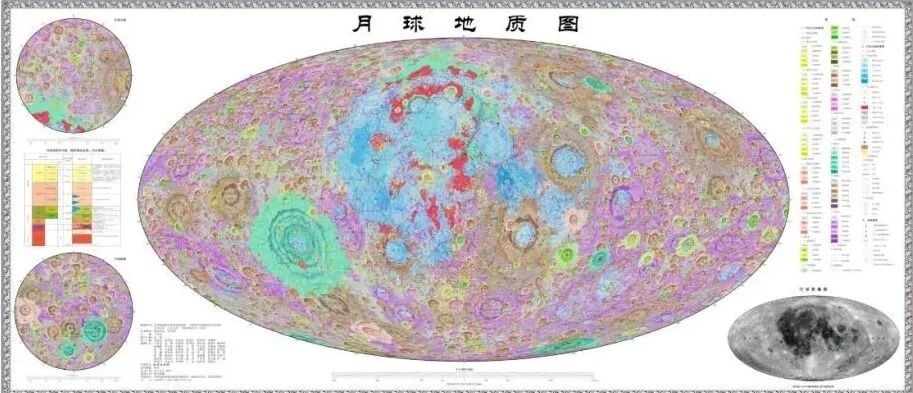
The Institute of Geology of the Chinese Academy of Geological Sciences (Zhongguo Dizhi Kexueyuan Dizhi Yanjiusuo 中国地质科学院地质研究所) completed the world’s first comprehensive 1:5 million scale global geologic map of the Moon.
This isn’t just another map.
We’re talking about a game-changing resource that could reshape how humanity explores and understands Earth’s nearest neighbor.

TeamedUp Intelligence
China Tech Salary Benchmarks:
- Millions of Verified Salary Datapoints
- P25, Median & P75 Comp Bands
- Tier 1–3 Cities & Tech Roles
- Interactive Visual Data Explorer
- AI Agent & MCP / REST API Ready
What Makes This Lunar Map So Significant?
Let’s break down the scale of what was accomplished here.
The main lunar geologic map measures approximately 280 centimeters in length and 120 centimeters in height.
That’s a massive physical document that captures an incredibly detailed picture of the Moon’s surface.
Here’s what the map includes:
- Over 13,000 impact craters precisely marked and catalogued
- 81 impact basins identified and documented
- 14 types of geological structures classified and visualized
- 17 types of rock categories distinguished across the lunar surface
To put this in perspective, this level of detail gives scientists and lunar explorers an unprecedented resource for planning future missions and understanding the Moon’s geological history.

The Three Major Innovations Behind the Map
The Chinese research team didn’t just compile existing data.
They achieved what they’re calling systemic innovation across three major areas.
Let’s dive into each one.
Innovation #1: Recalibrating the “Lunar Clock”
Understanding the Moon’s age and geological timeline is crucial for space exploration.
The team conducted a sophisticated revision of lunar geological chronology based on the latest research findings.
Here’s what changed:
- The Pre-Nectarian period (Aiken Ji 艾肯纪) starting age adjusted to 4.33 billion years
- The Nectarian period (Jiuhai Ji 酒海纪) recalibrated to 4.17 billion years
- The Early Imbrian period (Yuhai Ji 雨海纪) fine-tuned to 3.92 billion years
This is the first time that late-stage lunar strata have been subdivided with this level of precision on a global scale.
Why does this matter?
Accurate geological timelines help scientists understand how the Moon evolved, which directly informs theories about our entire solar system’s history.
Innovation #2: Updating the Lunar “Material Inventory”
The team used high-resolution distribution maps of key lunar minerals to optimize how rocks are classified on the Moon.
They drew on the latest discoveries from two major Chinese lunar missions:
- Chang’e 4 (Chang’e Si Hao 嫦娥四号)
- Chang’e 6 (Chang’e Liu Hao 嫦娥六号)
The breakthrough discovery?
A new rock category called “gabbronorite” was identified within the South Pole-Aitken Basin.
This discovery is huge because it allows humanity to directly examine materials from the deep interior of the Moon.
That’s not something we could do before.
These deep lunar materials can reveal critical information about the Moon’s internal structure and composition.
Innovation #3: Customizing a “Dedicated Magnifying Glass”
Creating a 1:5 million scale map presents a unique challenge: how do you make something that’s massive and detailed without losing readability?
The team solved this by establishing differentiated minimum expression scales for various geological features.
In practical terms, this means:
- The map remains readable and usable at full scale
- Critical geological characteristics with scientific significance are never overlooked
- Each feature is represented at an optimal level of detail for its importance
It’s the kind of technical problem-solving that separates good maps from exceptional ones.

Find Top Talent on China's Leading Networks
- Post Across China's Job Sites from $299 / role
- Qualified Applicant Bundles
- One Central Candidate Hub
Your First Job Post Use Checkout Code 'Fresh20'
Why This Matters for the Future of Space Exploration
Yang Zhiming (Yang Zhiming 杨志明), Director of the Institute of Geology of the Chinese Academy of Geological Sciences, emphasized that this map serves multiple critical purposes:
- Vital support for China’s International Lunar Research Station (ILRS) construction – planners now have unprecedented detail for site selection and facility planning
- Optimized landing site selection – future missions can choose locations based on detailed geological understanding
- Deep space exploration strategy – the knowledge gained feeds into broader lunar and solar system research goals
Beyond China’s programs, this map represents a new Chinese contribution to humanity’s exploration of the evolution of the solar system.
In other words, this isn’t just for Chinese missions.
Any space agency or research organization working on lunar exploration now has access to one of the most comprehensive geological resources ever created.

ExpatInvest China
Grow Your RMB in China:
- Invest Your RMB Locally
- Buy & Sell Online in CN¥
- No Lock-In Periods
- English Service & Data
- Start with Only ¥1,000
The Bigger Picture: China’s Lunar Ambitions
This geologic map is the latest major milestone in China’s Chang’e Project (Chang’e Gongcheng 嫦娥工程), the country’s ambitious lunar exploration program.
The program has already successfully landed robotic missions on the Moon, and this detailed geological map represents the scientific foundation for what’s coming next.
With the International Lunar Research Station on the horizon, expect China to leverage this mapping data to make strategic decisions about where humans and equipment will go on the Moon.

Resume Captain
Your AI Career Toolkit:
- AI Resume Optimization
- Custom Cover Letters
- LinkedIn Profile Boost
- Interview Question Prep
- Salary Negotiation Agent
What This Means for Lunar Science Going Forward
The release of this global lunar geologic map fundamentally changes what’s possible in Moon research and exploration.
Scientists, engineers, and mission planners now have:
- A standardized reference for lunar geology at unprecedented detail
- Clear classification systems for lunar rocks and geological structures
- Updated timelines for lunar geological history
- Evidence of previously undocumented lunar materials from the Moon’s interior
This is the kind of foundational work that enables decades of future research and exploration.
It’s also a reminder of how detailed lunar mapping isn’t just scientifically interesting—it’s operationally essential for anyone planning to spend significant time or resources on the Moon.

References
- China CompLetes New Version of GLobal Lunar Geologic Map – CCTV News (Yangshi Xinwen 央视新闻)
- Institute of Geology – Chinese Academy of Geological Sciences (Zhongguo Dizhi Kexueyuan Dizhi Yanjiusuo 中国地质科学院地质研究所)
- Lunar Exploration and Space Engineering Center – Chinese Academy of Sciences (Zhongguo Kexueyuan 中国科学院)
- A 1:2,500,000-scale geologic map of the global Moon – Nature Communications