Key Points
- Goldman Sachs (Gao Sheng 高盛) upwardly revised global optical module forecasts by over 20%, expecting total shipments to reach 729 million units and a market size of $148 billion USD by 2028, driven by AI infrastructure spending and high-speed upgrades (1.6T, 3.2T).
- Chinese optical module concept stocks show significant demand, with “Prepayments + Inventories of Goods Shipped” exceeding ¥116.8 billion RMB ($16.35 billion USD) by June 2026, indicating strong order flow and supply chain readiness.
- The industry is rapidly transitioning from 800G to 1.6T and 3.2T modules; a single GB200 server requires 162 units of 1.6T modules, projecting explosive revenue growth from higher unit counts and prices.
- Several Chinese companies, including Huagong Tech (Huagong Keji 华工科技) and San’an Optoelectronics (San’an Guangdian 三安光电), are already delivering or verifying 800G and 1.6T products, showing a functional ecosystem.
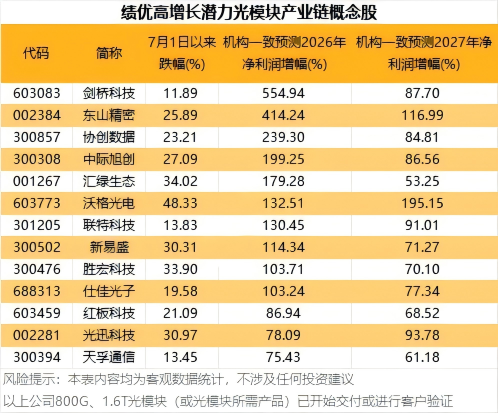
- Amidst a recent market dip, 13 companies are projected to maintain over 50% net profit growth in both 2026 and 2027, with Cambridge Industries (Jianqiao Keji 剑桥科技) expected to exceed 550% growth.
The optical module market is having a moment.
After a brutal July selloff, A-share optical module stocks staged a massive comeback in August and September.
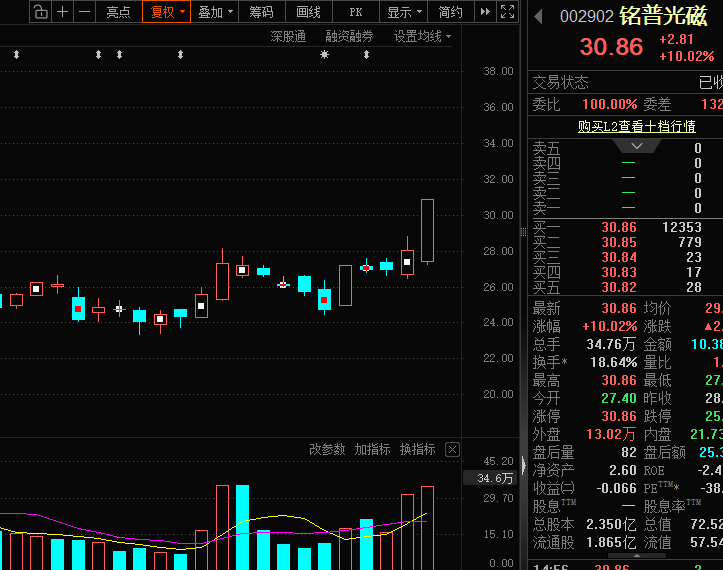
On September 11, Mentech Optical & Magnetic (Mingpu Guangci 铭普光磁) hit the daily price limit—a sign institutional money is flowing back in.
Since August, the stock surged over 48%, fully recovering July’s losses.
But this isn’t just one company catching a bid.
Something bigger is happening in the optical module sector.
And the catalyst? Goldman Sachs (Gao Sheng 高盛) just raised its forecasts by more than 20%.
Goldman Sachs Upwardly Revises Global Optical Module Forecasts
Goldman Sachs (Gao Sheng 高盛) released a bombshell report recently.
They’re bullish on optical modules—and they’ve put numbers behind it.
The firm upwardly revised forecasts for global optical module shipments from 2026 to 2028 by over 20% compared to previous estimates.
Three factors are driving this optimism:
- Increased AI infrastructure spending—hyperscalers (Chaogui Yunfu 超规云服) are going all-in on AI compute
- Product upgrades toward high-speed transmission—the industry is moving from 800G to 1.6T to 3.2T
- Rising adoption of optical interconnects—as server port speeds increase, optical becomes non-negotiable
The numbers paint a massive opportunity.
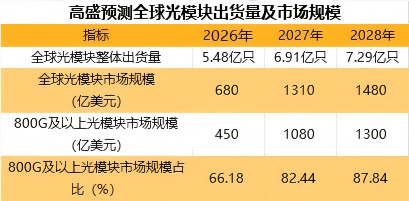
By 2028, Goldman Sachs (Gao Sheng 高盛) expects total global optical module shipments to reach 729 million units.
That’s a market size of $148 billion USD (approximately ¥1.036 trillion RMB).
Comparing 2028 to 2026 levels:
- +33.03% increase in shipments
- +117.65% increase in market size
Ultra-high-speed modules—1.6T and above—saw even higher upward revisions.
This is the critical segment for next-generation AI computing interconnects.
China’s Optical Module Supply Chain Is Stocked and Ready
- Luster LightTech: ¥839 Million RMB (+160% vs 2025)
- Ruijie Networks: +90% increase vs 2025
- Suzhou TFC Optical: +90% increase vs 2025
- Eoptolink Technology: ¥12.3 Billion RMB (+99% vs 2025)
Here’s what separates hype from reality: supply chain readiness.
In China, optical module concept stocks are showing massive order flow indicators.
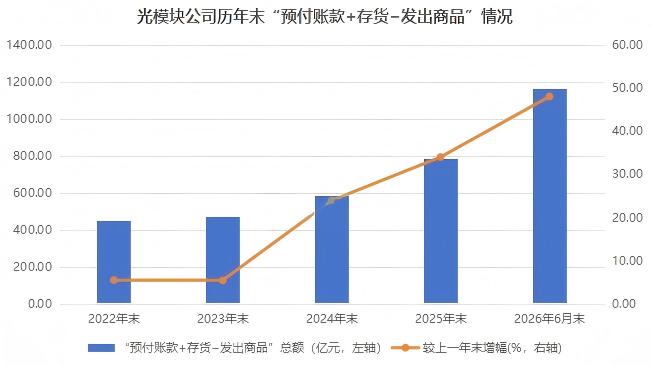
Guosheng Securities (Guosheng Zhengquan 国盛证券) conducted research on a key metric: “Prepayments + Inventories of Goods Shipped.”
Think of this as an “ammunition depot” for future deliveries—capital tied up in products that haven’t yet converted to revenue.
The data is striking.
Across 41 A-share optical module concept stocks from 2021 to June 2026:
- Total “Prepayments + Inventories of Goods Shipped” exceeded ¥116.8 billion RMB ($16.35 billion USD) by end of June 2026
- That’s up 48% from end of 2025
- And a 1.73x increase from end of 2021
More telling: prepayments alone exceeded ¥10.5 billion RMB ($1.47 billion USD) as of late June 2026.
That’s a 120% year-over-year increase.
Translation: customers are pre-paying for optical modules they need.
This isn’t speculative demand—it’s real deployment capital.
More than 60% of optical module concept stocks saw their “Prepayments + Inventories of Goods Shipped” increase by over 30% compared to year-end 2025.
Some standouts:
- Luster LightTech (Lianxun Yi-qi 联讯仪器): Reached over ¥839 million RMB ($117.5 million USD) by late June—a 160% increase from 2025
- Ruijie Networks (Ruijie Wangluo 锐捷网络): Saw increases exceeding 90%
- Suzhou TFC Optical Communication (Tianfu Tongxin 天孚通信): Also surpassed 90%
- Eoptolink Technology (Xin Yisheng 新易盛): Reached nearly ¥12.3 billion RMB ($1.72 billion USD), up nearly 99%

TeamedUp Intelligence
China Tech Salary Benchmarks:
- Millions of Verified Salary Datapoints
- P25, Median & P75 Comp Bands
- Tier 1–3 Cities & Tech Roles
- Interactive Visual Data Explorer
- AI Agent & MCP / REST API Ready
The Shift From 800G to 1.6T (and Beyond) Is the Real Story
Last year, 800G optical modules became the mainstream configuration for hyperscale data center (Shuju Zhongxin 数据中心) interconnects.
But the industry is already moving on.
By 2028, Goldman Sachs (Gao Sheng 高盛) expects that 800G and higher-speed modules will account for nearly 88% of the global market.
That’s an increase of nearly 22 percentage points from 2026.
The real growth driver?
1.6T and 3.2T modules.
1.6T completed verification and is beginning commercial deployment in 2025.
It’s taking over as the primary growth engine.
Why the rapid upgrade cycle?
Three reasons converge:
- Rising AI compute capital expenditures—hyperscalers aren’t slowing down
- Generational price-performance increases—1.6T modules deliver better value than 800G per unit cost
- AI demand extends beyond training to inference—video generation, real-time multimodal inference, Robot (Jiqiren 机器人) applications all require massive interconnect capacity
Here’s the kicker on unit volume.
A single GB200 server requires as many as 162 units of 1.6T optical modules to ensure data transmission efficiency.
That’s a massive increase in quantity per deployment.
Higher unit prices + higher unit counts per server = explosive revenue growth.
Institutional Consensus on 1.6T+ Rollout
Institutions have reached alignment on the 1.6T+ trajectory.
Goldman Sachs (Gao Sheng 高盛) predicts:
- Global 1.6T shipments: 33 million units in 2026 → 71 million units in 2027
- Global 3.2T shipments: 23 million units in 2027 → 68 million units in 2028
Nomura Securities independently predicts that 800G and 1.6T shipments will double significantly in 2026, with the upward cycle lasting through 2027.
Chinese Suppliers Already Shipping 800G and 1.6T Modules
This isn’t future talk.
Several listed Chinese companies are already delivering or sending optical modules for customer verification.
- Huagong Tech (Huagong Keji 华工科技): 1.6T modules being delivered in batches to domestic and international integrators and distributors
- San’an Optoelectronics (San’an Guangdian 三安光电): 400G and 800G optical chips shipped in bulk; 1.6T chips sent for verification
- Linktel Technologies (Liante Keji 联特科技): Bulk shipments of 800G modules underway; 1.6T products under testing with multiple customers
- Ultrasonic Electronics (Chaosheng Dianzi 超声电子): Building technical reserves for 1.6T+ products
- Ruijie Networks (Ruijie Wangluo 锐捷网络): Building technical reserves for 1.6T+ products
Nearly 30 companies across the supply chain have confirmed they’ve begun delivery or sample verification for 800G and 1.6T+ products.
The ecosystem is real and functioning.
13 High-Performance Optical Module Stocks to Watch
Despite the strong tailwinds, the sector faced headwinds in H2 2024.
As of September 11, the average stock price of companies with confirmed 800G and 1.6T+ delivery has fallen nearly 23% since July 1.
But not all stocks fell equally.
Winners:
- Qiangda Circuit (Qiangda Dianlu 强达电路): +16%
- Unisplendour (Ziguang Gufen 紫光股份): Gained against the trend
- Founder Technology (Fangzheng Keji 方正科技): Gained against the trend
Losers:
- Wogee (Woge Guandian 沃格光电): Down over 40%
- Huagong Tech (Huagong Keji 华工科技): Down over 40%
- Zhongtian Technology (Zhongtian Keji 中天科技): Down over 40%
Looking forward to 2026 and 2027, institutions expect 13 companies to maintain net profit growth exceeding 50% in both years.
These are the growth leaders:
The Top Growth Stories
1. Cambridge Industries (Jianqiao Keji 剑桥科技)
- 2026 projected net profit growth: Exceeds 550%
- Achieved simultaneous expansion of 800G and 1.6T production lines at multiple domestic and overseas factories in H1 2024
- Positioned as the pure-play 1.6T growth story
2. Dongshan Precision (Dongshan Jingmi 东山精密) — East Money Subsidiary
- 2026 projected net profit growth: Over 400%
- 1.6T work proceeding as planned
- 3.2T products will leverage Source Photonics’ proprietary chips—technical advantage built in
3. Zhongji Innolight (Zhongji Xuchuang 中际旭创)
- 2026 projected net profit growth: Nearly 200%
- 1.6T products already shipping in volume
- Scale advantage as demand ramps
4. Hichain Logistics (Xiechuang Shuju 协创数据)
- Ranked in top growth leaders by 2026 projected net profit growth
- Positioned to benefit from data center infrastructure buildout

Find Top Talent on China's Leading Networks
- Post Across China's Job Sites from $299 / role
- Qualified Applicant Bundles
- One Central Candidate Hub
Your First Job Post Use Checkout Code 'Fresh20'
The Bottom Line on Optical Modules
The optical module sector is experiencing a multi-year growth cycle driven by AI infrastructure buildout.
Goldman Sachs (Gao Sheng 高盛) raising forecasts by 20%+ signals institutional conviction.
Chinese suppliers are already shipping 800G and moving 1.6T into commercial deployment.
Order flow metrics (prepayments + inventories) suggest demand is real, not speculative.
The transition from 800G to 1.6T to 3.2T over the next 3 years creates a secular growth tailwind for well-positioned suppliers.
The 13 companies expected to grow net profit 50%+ annually in 2026-2027 are positioned at the center of this transformation.
For investors, founders, and strategists watching AI infrastructure trends, optical modules deserve attention.
This is a real and quantifiable growth opportunity in Chinese tech.