Key Points
- Regulatory review: The U.S. Commerce Department (Meiguo Shangwubu 美国商务部) review is considering allowing Nvidia (Yingweida 英伟达) to export H200 AI accelerators to China — a move that would signal a meaningful policy shift on high-end chip exports.
- Performance lift: The H200 offers substantially more high-bandwidth memory and industry estimates suggest it delivers roughly double the performance of the H100 in certain large-scale AI workloads.
- Market impact & stats: Nvidia executives said the company faced near-zero China revenue in some quarters due to restrictions; management referenced a historic peak market cap near $5 trillion USD, while the stock saw short-term volatility including weekly declines near 6%.
- Broader implications: Approval would widen Chinese access to higher-end AI compute, affect cloud providers, enterprise refresh cycles, investor sentiment, and serve as a signal about U.S.–China geopolitical and supply-chain dynamics.
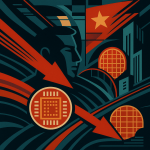
Nvidia H200 chips to China are at the center of a potential policy shift that could reshape AI compute access and U.S.–China tech dynamics.
Summary — Nvidia H200 chips to China and why it matters
U.S. officials are reportedly reviewing whether to allow Nvidia (Yingweida 英伟达) to export its H200 AI accelerator chips to China.
The review was first reported by international media and was picked up by Chinese outlets.
The potential move comes amid signs of easing bilateral tensions and after renewed public appeals from Nvidia leadership to relax export restrictions.

Find Top Talent on China's Leading Networks
- Post Across China's Job Sites from $299 / role
- Qualified Applicant Bundles
- One Central Candidate Hub
Your First Job Post Use Checkout Code 'Fresh20'

What Reuters reported — export controls and the review
Reuters reported that the U.S. Commerce Department (Meiguo Shangwubu 美国商务部) is examining a possible change to export controls that have limited sales of higher-end AI chips to China.
The review would consider whether Nvidia can sell its H200 chips to Chinese customers.
Reuters cited unnamed sources familiar with the matter and warned the plan could change as the review proceeds.
The Commerce Department had no immediate public comment.
Nvidia did not issue an immediate response to the report.

ExpatInvest China
Grow Your RMB in China:
- Invest Your RMB Locally
- Buy & Sell Online in CN¥
- No Lock-In Periods
- English Service & Data
- Start with Only ¥1,000
Why the H200 matters — performance, memory, and AI compute
The H200 is the successor to Nvidia’s H100 AI accelerator.
Public technical summaries indicate the H200 includes more high-bandwidth memory and delivers substantially higher performance for large-scale AI training and inference workloads.
Industry commentary says the upgrade gives the H200 roughly double the performance of the H100 in certain workloads.
Allowing U.S. exports of H200-class chips to China would mark a notable shift in policy.
Past export controls were designed to limit the most-advanced AI compute from reaching certain markets.

Resume Captain
Your AI Career Toolkit:
- AI Resume Optimization
- Custom Cover Letters
- LinkedIn Profile Boost
- Interview Question Prep
- Salary Negotiation Agent
What Nvidia executives have said — China’s strategic importance
Nvidia CEO Jensen Huang (Huang Renxun 黄仁勋) has repeatedly stressed the importance of the Chinese market for the company’s long-term competitiveness.
Huang has publicly urged stabilization of U.S.–China trade ties and warned that restrictions that harm China can also harm U.S. interests.
On calls and in interviews this fall Huang noted that U.S. export limits had effectively halted sales of some higher-end products to China.
He said the company expected near-zero revenue from China for certain quarters as a result of export limits.
At the company’s most recent quarterly earnings call, CFO Colette Kress (Colette Kress 科莱特·克雷斯) said that geopolitical tensions and fierce competition in China meant Nvidia missed large China orders in the third quarter.
Internal remarks that made headlines — the PR dilemma
Business Insider reported on an internal memo and a meeting recording in which Jensen Huang acknowledged a difficult public-relations predicament for Nvidia.
He said Nvidia faces a “no-win” situation: if the company posts outstanding results, critics will call it fanning an “AI bubble”.
He said if results disappoint, others will point to a bubble bursting.
Huang noted investor expectations are extremely high and joked about the company’s past valuation.
Huang referenced the company’s historic peak market value, saying there was a period when Nvidia’s market capitalization approached $5 trillion USD.
That figure was provided in his remarks alongside a conversion: ¥36.5 trillion RMB ($5,000,000,000,000 USD ≈ ¥36,500,000,000,000 RMB, using an illustrative exchange rate of ¥7.3 per $1 USD).
He also remarked — again jokingly — that rapid swings had produced headline losses on the order of $500 billion USD (≈ ¥3.65 trillion RMB).
Market reaction — volatility after strong results
Even after strong quarterly results and raised guidance that beat analysts’ expectations, Nvidia shares saw selling pressure.
The stock closed lower for two consecutive trading days after the earnings release.
Weekly declines near 6% were reported following the results.
The volatility reflects investor debate about the sustainability of AI-driven revenue and the role of geopolitics in market access.
China’s official stance and diplomatic notes
At a routine briefing, a Chinese Foreign Ministry spokesperson referred questions about foreign companies selling AI chips in China to the relevant Chinese regulatory departments.
Beijing reiterated that Washington should take practical actions to stabilize global supply chains.
China has previously urged the U.S. to avoid measures that disrupt trade in semiconductors and related technologies.
Why this matters — three quick takeaways
- Technology access: A policy change permitting H200 exports would widen Chinese access to higher-end AI compute hardware, affecting AI research, cloud providers, and chip-consuming industries in China.
- Geopolitics and supply chains: The decision would be a signal about U.S.–China relations and could influence how other advanced technology exports are treated.
- Market expectations: Nvidia’s business closely ties to advanced hardware supply and global demand for AI infrastructure, so export policy changes can materially affect revenue outlooks and investor sentiment.
Background: H200 vs. H100 — what’s the practical difference?
The H200 family was introduced after the H100 generation and is positioned as a higher-performance AI accelerator with expanded high-bandwidth memory capacity.
Industry commentary treats the H200 as a notable step up for large-scale model training efficiency.
U.S. export controls historically focus on preventing the most-advanced compute — especially generations that meaningfully accelerate large-language-model training — from reaching actors of concern.
Whether H200 falls on a restricted list depends on technical classifications and policy choices by regulators.
Practical implications for investors, founders, and tech leaders
If the export review moves toward approval, expect:
- Cloud providers and Chinese AI labs to potentially gain access to faster training compute, which can shorten time-to-insight and experimentation cycles.
- Enterprise buyers in China to evaluate refresh cycles for AI infrastructure sooner than expected.
- Investors to reprice risk and growth potential for companies that rely on cross-border sales or global supply chains.
If restrictions remain, expect:
- Continued pressure on companies that rely on large China revenues.
- Acceleration of local alternatives as domestic players and cloud providers seek to fill gaps.
- Ongoing regulatory friction that keeps geopolitics a core variable in growth forecasts.
Bottom line
This potential review by the U.S. Commerce Department over Nvidia H200 chips to China is a live policy story with commercial, technical, and geopolitical angles.
It’s a decision that could change hardware access for Chinese AI developers and send a policy signal to markets and global suppliers.
Watch regulatory guidance, Nvidia statements, and responses from Chinese regulators closely as this unfolds.
Nvidia H200 chips to China will be a defining indicator of where U.S.–China technology policy is headed next.