Key Points
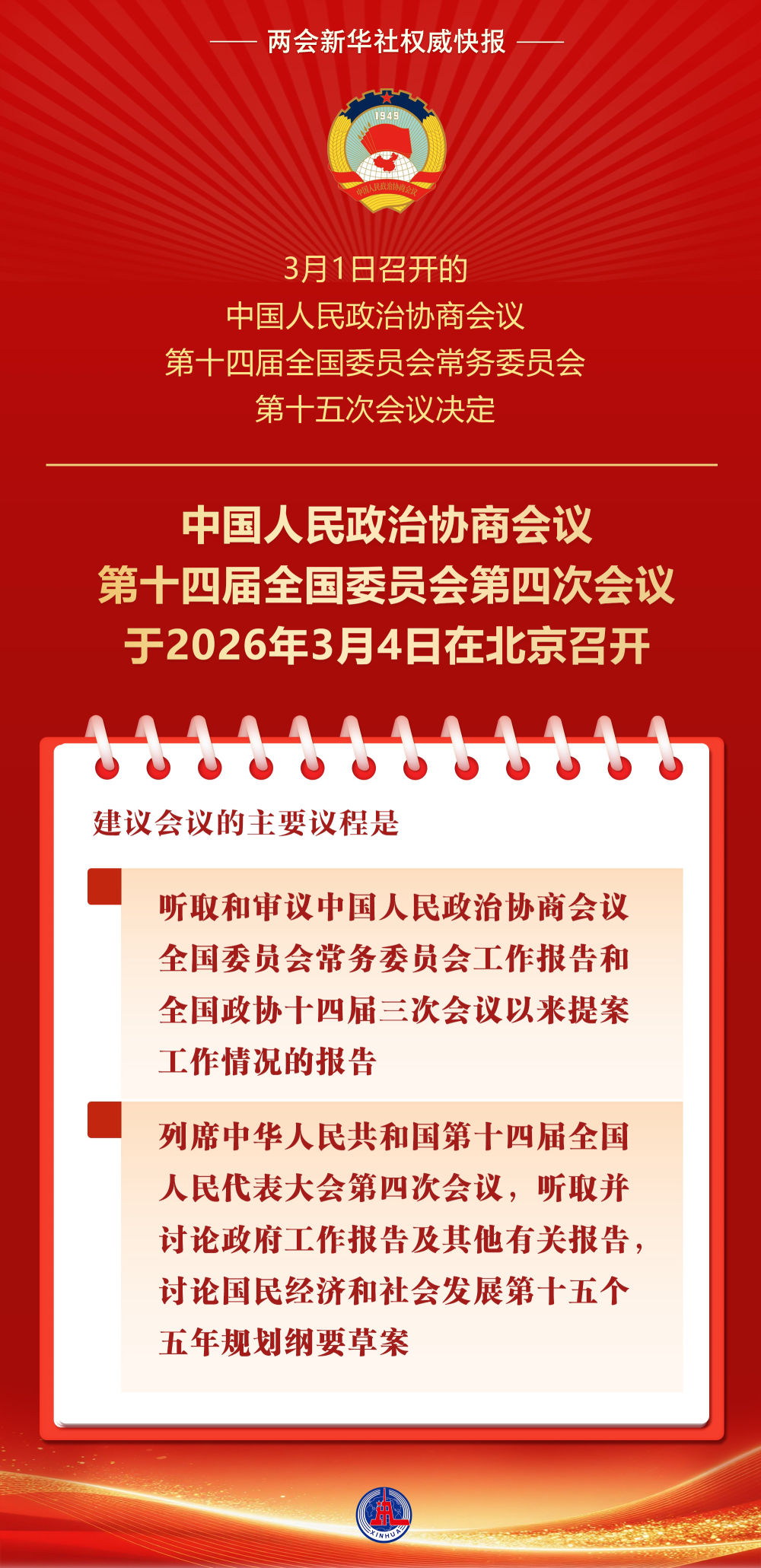
- The Fourth Session of the 14th National Committee of the CPPCC (Chinese People’s Political Consultative Conference) will convene on March 4, 2026, in Beijing.
- Key agenda items include reviewing the Standing Committee’s work report, deliberating on the Government Work Report, and most importantly, discussing the draft of the 15th Five-Year Plan (2026-2030).
- The CPPCC is China’s top political advisory body, composed of prominent figures, and its discussions provide crucial signals for China’s strategic direction, particularly for tech and business sectors.
- Discussions around the 15th Five-Year Plan will define national priorities in areas like AI, advanced computing, green energy, semiconductor self-sufficiency, and the digital economy for the next half-decade.
- The session’s outcomes will significantly impact tech sector support, regulatory direction, innovation priorities, and the stance on foreign investment, making March 2026 a critical signal moment for investors and entrepreneurs.

On March 1, 2026, something pretty significant happened in Beijing.
The Standing Committee of the 14th National Committee of the Chinese People’s Political Consultative Conference (Zhongguo Renmin Zhengzhi Xieshang Huiyi 中国人民政治协商会议) — or CPPCC for short — officially announced that the Fourth Session will convene on March 4, 2026.
If you’re an investor, founder, or tech executive tracking China’s policy direction, this matters.
Here’s why: the CPPCC is where China’s political and business elite gather to shape the country’s strategic direction for the next five years.
Think of it as a high-stakes planning session that influences everything from tech regulation to economic stimulus.
What’s Actually on the Agenda?
- Reviewing the Standing Committee Work Report
- Reviewing the Proposal Handling Report
- Participating in the National People’s Congress (non-voting)
- Discussing the Government Work Report
- Deliberating the Draft 15th Five-Year Plan
The session agenda includes several major items worth paying attention to:
1. Standing Committee Work Report Review
The first order of business is hearing and deliberating the work report of the Standing Committee.
This is basically the CPPCC’s internal review of what they’ve accomplished and where they’re heading.
For tech watchers, this typically reveals shifts in policy priorities around innovation, regulation, and corporate governance.
2. Proposal Handling Report
The committee will also review the report on how proposals have been handled since the last session.
This matters because it shows which proposals got traction and which got shelved.
It’s a transparent look at what the government is actually prioritizing versus what sounds good on paper.
3. Non-Voting Participation in the National People’s Congress
Here’s an interesting structural detail: CPPCC delegates will sit in as non-voting participants at the Fourth Session of the National People’s Congress (Quanguo Renmin Daibiao Dahui 全国人民代表大会).
This dual-session arrangement means CPPCC members get a front-row seat to policy discussions, even if they don’t have direct voting power.
It’s a way to ensure advisory input flows into actual legislative decisions.
4. Government Work Report & Supporting Documents
The session will include hearing and discussing the Government Work Report, plus other relevant reports from various government bodies.
This is the big one.
The Government Work Report typically outlines China’s economic targets, policy priorities, and strategic initiatives for the year ahead.
For tech founders and investors, this is where you learn about:
- Tech sector support — which industries get subsidies or preferential treatment
- Regulatory direction — which sectors face tighter oversight
- Innovation priorities — whether AI, semiconductors, green tech, or something else is being pushed
- Foreign investment stance — how welcoming China will be to international capital

Find Top Talent on China's Leading Networks
- Post Across China's Job Sites from $299 / role
- Qualified Applicant Bundles
- One Central Candidate Hub
Your First Job Post Use Checkout Code 'Fresh20'
5. The 15th Five-Year Plan Discussion
And here’s the headline item: the committee will be discussing the draft of the 15th Five-Year Plan (Shi Wu Wu 十五五) for National Economic and Social Development.
This is huge.
Five-year plans in China aren’t suggestions — they’re strategic blueprints that shape everything from infrastructure spending to corporate incentives.
The 15th Five-Year Plan will cover roughly 2026-2030, a critical period for:
- AI and advanced computing — where China is investing heavily to compete globally
- Green energy transition — battery tech, solar, wind, and EV infrastructure
- Semiconductor self-sufficiency — a key national priority given U.S. export controls
- Healthcare innovation — biotech, medical devices, and domestic pharmaceutical development
- Digital economy expansion — cloud computing, data security, and blockchain applications
Why This Matters for Investors & Entrepreneurs
If you’re watching China’s tech and business landscape, the CPPCC session is a key signal moment.
Policy announcements made here ripple through the entire Chinese economy.
Companies start positioning themselves based on what they hear.
Investment capital flows toward favored sectors.
Regulation either tightens or loosens depending on the political guidance.
The 15th Five-Year Plan discussion is especially important because it’ll give early signals about:
- Which industries get the green light for expansion
- Where government will increase oversight or control
- What funding and subsidies will be available for startups and established players
- How China plans to compete in global tech races (semiconductors, AI, quantum computing)
What’s the CPPCC Anyway?
Quick context if you’re new to Chinese governance:
The CPPCC is China’s top political advisory body.
It’s not the legislature (that’s the National People’s Congress), but it has significant soft power and influence over policy direction.
Members include:
- Prominent politicians and government officials
- Business leaders and entrepreneurs (this is who pays attention in the startup world)
- Academics, artists, and cultural figures
- Representatives from various sectors and regions
Think of it as an elite consensus-building mechanism.
When the CPPCC aligns around a policy direction, you can bet it’s coming.
The Timing: Why March 2026?
The Fourth Session happening in early March 2026 is strategically timed.
It falls right before the major legislative sessions in Beijing, which means any consensus built in the CPPCC becomes the framework for actual laws and policies.
This is when:
- Budget allocations for the year get finalized
- Tech sector priorities get officially endorsed
- Regulatory approaches get calibrated
- International business relations get signaled
Bottom Line: What You Should Watch
If you’re tracking China’s tech landscape, March 2026 is a critical moment.
The announcements, discussions, and policy signals coming out of the CPPCC Fourth Session — especially around the 15th Five-Year Plan — will set the tone for the next half-decade of Chinese tech and business.
Keep an eye on:
- AI policy clarity — how much freedom do companies have to train models and deploy systems?
- Semiconductor priorities — is China doubling down on domestic chip independence?
- Platform regulation outlook — will tech giants face more restrictions or will there be relief?
- Startup ecosystem support — what funding and incentives are being put behind new ventures?
- International stance — how open or restrictive will policy be toward foreign investment?
The CPPCC agenda is now set.
The decisions made in March 2026 will define China’s tech and business trajectory for years to come.
—