Key Points
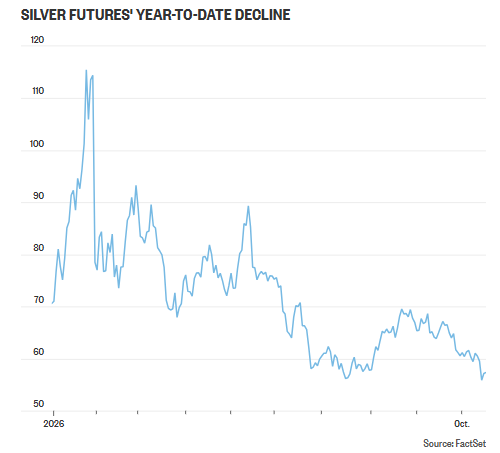
- Silver has crashed more than 50% from its January peak of $121.79 USD (¥868.52 RMB) per ounce, closing recently at $57.31 USD (¥408.69 RMB). In contrast, gold dropped just over 25% from its peak.
- Silver’s dramatic decline is a significant economic indicator due to its dual role as a monetary precious metal and an industrial commodity (roughly 50/50 split), making it more sensitive to economic cycles than gold.
- The silver crash coincides with soaring energy prices, with US benchmark crude oil up over 70% this year and US diesel prices up nearly 78% since late last year to $6.30 USD (¥44.93 RMB) per gallon, signaling potential economic slowdown.
- Silver is more susceptible to investor sentiment and volatility as it lacks the strategic central bank buying that supports gold prices.
- Despite short-term volatility, long-term demand for silver is projected to grow due to its critical role in AI infrastructure and data centers, with the physical silver market expected to face a supply deficit by 2026.
- Global energy price surge (Crude Oil >70%, Diesel >77%)
- Stagnating industrial demand vs. Speculative cooling
- US Consumer Price Index (CPI) exceeding expectations (3.7% YoY)
- Loss of discretionary purchasing power due to inflation
Silver just hit a troubling milestone.
The precious metal—which typically moves before the broader economy does—has dropped below the halfway point relative to its record high from earlier this year.
And if you’re paying attention to what’s happening in commodities, currencies, and energy markets, this matters way more than you might think.
The Dramatic Silver Collapse: By The Numbers
Let’s start with the raw data, because it’s pretty stark.
According to Dow Jones Market Data, silver hit an intraday record of $121.79 USD (¥868.52 RMB) per ounce in late January.
That was the peak.
Then it happened—a more than 50% plunge.
Even after a slight recovery in Q3, silver closed last Friday at just $57.31 USD (¥408.69 RMB) per ounce.
That’s a gut-punch decline for anyone tracking commodity markets.
Here’s what makes this even more interesting: gold didn’t fall nearly as hard.
The yellow metal dropped just over 25% from its January peak of $5,626.80 USD (¥40,126.54 RMB) per ounce.
So why did silver crater while gold held up better?
That question is driving some serious conversations among market watchers right now.

TeamedUp Intelligence
China Tech Salary Benchmarks:
- Millions of Verified Salary Datapoints
- P25, Median & P75 Comp Bands
- Tier 1–3 Cities & Tech Roles
- Interactive Visual Data Explorer
- AI Agent & MCP / REST API Ready

Why Silver Matters More Than You Think
Here’s the thing about silver that most casual investors don’t realize: it’s a hybrid asset.
Unlike gold, which is primarily a store of value and a safe haven, silver plays two roles at once:
- Monetary precious metal — people buy it as a hedge and store of wealth
- Industrial commodity — manufacturers and tech companies actually need it for production
This dual nature makes silver far more sensitive to economic cycles than gold.
Stefan Gleason, President and CEO of Money Metals Exchange, put it plainly: silver’s recent weakness could serve as a leading indicator of underlying risks in the broader macroeconomy.
Translation? When silver starts tanking, smart money starts asking questions about what’s coming next.
The Real Warning Signal: Energy Prices Are Surging
Gleason pointed to something most financial media is glossing over: the decline in silver coincides with warning signals in energy markets.
And energy prices are sending some genuinely concerning messages.
Since the start of the year, US and global benchmark crude oil prices have surged more than 70%.
The culprit?
Ongoing conflicts in the Middle East affecting extraction and logistics.
But here’s where it gets scary for everyday people: the impact on refined fuel costs has been absolutely brutal.
According to GasBuddy data:
- Average US diesel prices have soared nearly 78% since the end of last year
- Diesel hit $6.30 USD (¥44.93 RMB) per gallon as of last Friday
When diesel doubles over six months, you’re not just looking at higher gas prices at the pump.
You’re looking at increased shipping costs, higher food prices, and inflation rippling through the entire economy.
Gleason was direct about what this means: “Persistently high energy prices are almost certain to lead to an economic slowdown, or perhaps something even more severe.”

Find Top Talent on China's Leading Networks
- Post Across China's Job Sites from $299 / role
- Qualified Applicant Bundles
- One Central Candidate Hub
Your First Job Post Use Checkout Code 'Fresh20'
Inflation Is Already Here—And Worse Than Expected
The warning signs are showing up in official data too.
In September, the US Consumer Price Index (CPI) rose 0.6% month-on-month and 3.7% year-on-year.
Meanwhile, the Producer Price Index (PPI) jumped 1.3% month-on-month, with a 6.3% year-on-year increase.
Almost every metric exceeded market expectations.
Dana Samuelson, President of American Gold Exchange, sees the silver decline as a direct reflection of what’s happening: silver prices “reflect some of the negative impacts that rising inflation is having on the global economy”.
Here’s his logic—and it’s sound:
For most people, gold and silver aren’t necessities.
They fall under discretionary spending.
When inflation erodes purchasing power, people cut back on wants and focus on needs.
Silver gets hit harder because it’s caught in the middle of that squeeze.
Samuelson explained it like this: “While it is difficult to accurately measure the extent of the economic shock caused by diesel prices doubling over the past six months, the market may be starting to feel the ‘initial ripples of this inflationary shock.'”

ExpatInvest China
Grow Your RMB in China:
- Invest Your RMB Locally
- Buy & Sell Online in CN¥
- No Lock-In Periods
- English Service & Data
- Start with Only ¥1,000
The 50-50 Split: Why Silver and Gold React Differently
This is where the breakdown gets really interesting.
Samuelson broke down the composition of each metal’s value:
- Silver: roughly 50% monetary, 50% commodity
- Gold: roughly 90% monetary, 10% commodity
That split explains everything about why we’re seeing such different price actions.
Gold’s strength comes from its status as pure store of value.
Central banks around the world have been buying gold—treating it as a strategic reserve.
That institutional demand has kept a floor under gold prices.
Silver, though?
Half its value comes from the commodity side—demand from manufacturing, technology, and industry.
When economic growth slows and industrial demand cools, silver gets crushed.

Resume Captain
Your AI Career Toolkit:
- AI Resume Optimization
- Custom Cover Letters
- LinkedIn Profile Boost
- Interview Question Prep
- Salary Negotiation Agent
The Investor Sentiment Problem
Robert Minter, Director of ETF Investment Strategy at Aberdeen Investments, added another layer to the analysis: silver is more susceptible to investor sentiment than gold.
Gold has something silver doesn’t: strategic central bank buying.
That creates a reliable bid under the market, regardless of what individual investors think.
Silver has no equivalent.
There’s no strategic buyer propping up the market when sentiment turns negative.
That makes silver far more vulnerable to mood swings and panic selling.
Silver’s Volatility Is Off The Charts
But here’s the thing: silver’s wild swings aren’t exactly a surprise to people who’ve studied this market long enough.
Ryan McIntyre, President of Sprott (Sipuotuo 思博伦/斯普罗特), explained that silver’s steeper decline is due to its “higher volatility characteristics, sensitive exposure to industrial demand, and the rapid cooling of previous speculative fervor”.
Earlier this year, traders figured out they could participate in the gold rally on a tighter budget by buying silver.
Silver was cheaper, moved faster, and had more leverage built in.
That triggered a speculative boom that couldn’t last forever.
When market conditions shifted, the selling started.
And when liquid markets start selling, things get ugly fast.
The Liquidity Squeeze: A Real-Time Example
Last Wednesday was a perfect example of how bad things can get.
According to Dow Jones Market Data:
- The most active December Comex silver futures fell 6.1%
- This was the largest single-day drop since June 24
- On the same day, gold prices fell by only 1.7%
What happened?
McIntyre described it perfectly: elevated inflation data triggered widespread panic in equity markets, which led to a “liquidity-driven sell-off” in both gold and silver.
When institutional investors need cash fast, they sell their most liquid positions first.
Precious metals, while valuable, often get dumped in a panic.
The good news?
According to McIntyre, once the selling pressure subsides and the dust settles, dip-buying usually drives a quick technical rebound.
These panic moves tend to be temporary—at least in the medium term.
The Long Game: AI and Data Centers Could Rescue Silver
While silver might be volatile in the short term, there’s a bigger story developing underneath all this noise.
Trevor Yates, Senior Investment Analyst at Global X ETFs, is looking at a structural trend that could change everything: artificial intelligence and data center expansion.
Here’s his thesis:
Huge capital expenditures on smart grid infrastructure and data transmission equipment continue to bolster industrial demand for silver.
Silver is critical for these applications.
As data centers proliferate and AI infrastructure scales globally, industrial demand for silver should climb.
Yates is “firmly optimistic that AI will serve as a major growth engine for silver demand over the next few years.”
And here’s the kicker: the physical silver market is expected to enter its sixth consecutive year of supply deficit by 2026.
If demand keeps rising and supply stays tight, that’s a recipe for higher prices down the road.
Yates emphasized that silver’s “increasing industrial application value” reinforces structural scarcity in ways that most casual observers aren’t paying attention to yet.
Looking Ahead: Silver as a Strategic Allocation
Despite all the near-term volatility and economic headwinds, Global X ETFs is increasingly viewing precious metals as a “highly attractive strategic allocation opportunity” when looking toward the 2027 investment landscape.
The current weakness in silver could be painting a temporary but important warning signal about the global economy.
Energy prices remain elevated.
Inflation is sticky.
Economic growth is showing signs of strain.
But from a longer-term perspective, the structural case for silver—driven by technological advancement and supply constraints—remains compelling.
For investors and founders tracking macro trends, silver’s recent collapse below the 50% mark isn’t just noise.
It’s a signal worth paying attention to—both as a warning about near-term economic risks and as a potential opportunity for those thinking several years ahead.